The starting point for the theoretical description of a
nonrelativistic electronic system is the time-dependent
Schrödinger equation (TDSE)
 |
(1) |
which determines the propagation in time of the  -particle system
evolving from its initial state
-particle system
evolving from its initial state
 |
(2) |
Although  fully describes the electronic system it is, of
course, not observable. In a typical collision problem one usually
measures the probabilities of finding some of the electrons in a
given state or at a certain place in configuration space. These
inclusive probabilities [6] can be expressed in terms of the q-particle
density [7]
fully describes the electronic system it is, of
course, not observable. In a typical collision problem one usually
measures the probabilities of finding some of the electrons in a
given state or at a certain place in configuration space. These
inclusive probabilities [6] can be expressed in terms of the q-particle
density [7]
 |
(3) |
where
 denotes coordinates and spin of the
 -th electron and
 indicates summation over spin and
integration over space coordinates, respectively. With the
definition (3)
indicates summation over spin and
integration over space coordinates, respectively. With the
definition (3)
 describes
the inclusive probability of finding
describes
the inclusive probability of finding  electrons at given
positions in configuration space, while the remaining
electrons at given
positions in configuration space, while the remaining  electrons are not detected explicitly. As a special case one
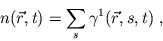
obtains for
electrons are not detected explicitly. As a special case one
obtains for  the spin-free one-particle density
 |
(4) |
which is the key for the understanding of DFT.
The total hamiltonian that enters the TDSE (1)
 |
(5) |
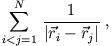
includes the kinetic energy, the mutual Coulomb repulsion between the
electrons
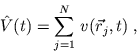
and the external potential
 |
(7) |
which characterizes the geometry as well as the explicit
time-dependence of the particular quantum system. This
decomposition of the Hamiltonian into a universal,
time-independent part (6) and a system-specific
time-dependent external potential is a second important ingredient
for the conceptual understanding of DFT.
Let us, thus, define a map
 by
solving the TDSE for different external potentials but common
initial state
by
solving the TDSE for different external potentials but common
initial state  . As the one-particle density is uniquely
determined by the time-dependent many-particle state
this obviously defines a second map
. As the one-particle density is uniquely
determined by the time-dependent many-particle state
this obviously defines a second map
 . The foundation of DFT involves the proof that the map
  is
invertible, i.e., can be obtained as a functional of the
one-particle density
is
invertible, i.e., can be obtained as a functional of the
one-particle density
 . As a
consequence any observable that can be written as an expectation
value
. As a
consequence any observable that can be written as an expectation
value
 of a Hermitian
operator would then be uniquely determined by
of a Hermitian
operator would then be uniquely determined by  .
More precisely the conditions under which is a 1-1 map
between the external potential and the one-particle density are
formulated by the Runge-Gross
theorem [8]:
.
More precisely the conditions under which is a 1-1 map
between the external potential and the one-particle density are
formulated by the Runge-Gross
theorem [8]:
- For every single-particle potential
 that can
be expanded into a Taylor series with respect to time around
that can
be expanded into a Taylor series with respect to time around
 there exists a map
by solving the TDSE with a fixed initial state . This map
can be inverted up to an additive merely time-dependent function
in the potential.
there exists a map
by solving the TDSE with a fixed initial state . This map
can be inverted up to an additive merely time-dependent function
in the potential.
At this point a few remarks might be appropriate: (i) As the
invertibility of the map between potentials and densities can only
be shown with respect to a given initial state , the
solution of the TDSE rigorously depends on the density and
the initial state. Consequently, any observable of the system is a
functional of  and . (ii) The potential as a functional
of is only determined up to a merely time-dependent function.
This corresponds to an ambiguity in up to a
time-dependent phase factor, which cancels out for any observable
characterized by an operator that is free of time derivatives.
(iii) The Runge-Gross theorem can be applied to any system
characterized by a given interaction
and . (ii) The potential as a functional
of is only determined up to a merely time-dependent function.
This corresponds to an ambiguity in up to a
time-dependent phase factor, which cancels out for any observable
characterized by an operator that is free of time derivatives.
(iii) The Runge-Gross theorem can be applied to any system
characterized by a given interaction  , in particular for
 . This fact is used in the subsequent section, where a
set of effective one-particle Schrödinger equations yielding the
exact one-particle density is derived.
. This fact is used in the subsequent section, where a
set of effective one-particle Schrödinger equations yielding the
exact one-particle density is derived.
H.J. Lüdde