Current: Novel High-Temperature-Superconductors: Iron pnictides

Possible symmetries of the order parameter in iron-based superconductors (negative: red, positive: blue)
(Hirschfeld, et al., Rep. Prog. Phys. 74, 124508 (2011))

Sketch of the anisotropic order parameter in LiFeAs (ARPES measurement)
(Borisenko, et al., Symmetry 4, 251 (2012))
Although the phenomena of superconductivity has been discovered experimentally more than 100 years ago by Kammerlingh Onnes in 1911, it is still subject to recent research in experiment and theory. A possible reason is that it appears in many different materials and a physical understanding hasn't been achieved in a universal theory yet. The effect of superconductivity which simply speaking manifests itself by complete expulsion of a magnetic field (Meißner effect) and conductance of electric current without loss is due to pairing of electrons to the so-called Cooper pairs. In conventional superconductors (which become superconducting at quite low temperatures below 23K) the attractive interaction is believed to be mediated by lattice vibrations and the essential physics has been understood quite some time ago in terms of the BCS theory.

Highest critical temperatures in various materials as function of time

The Fermi surface of KFe2-ySe2 consists in 2 patches centered around the X and Y point (color code: red: dxz orbital, green: dyz orbital, blue: dxy orbital).
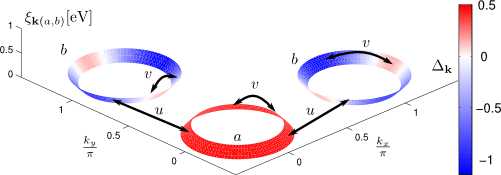
Model of a multiband superconductor with anisotropic order parameter and linearized dispersion.
(Wang, et al., Phys. Rev. B 87, 094504 (2013))
However, the whole understanding got screwed up by two experimental discoveries: In 1986 Bednorz and Müller discovered superconductivity in cuprate materials at such high temperatures where theoretically it shouldn't be possible within the known mechanisms. Up to now the microscopic origin of superconductivity in cuprates is still under debate whereas the materials easily entered into application due to the high transition temperatures above 100K. In 2008 Kamihara and collaborators reported superconductivity in doped iron pnictide materials which added another class of materials that are superconducting at high temperatures up to 55 K. Recently, active research has been carried out in this field because the materials show a rich phase diagram that contains an interplay between superconductivity, magnetism and crystal structure. Among the many known materials there are three compounds which are particularly interesting because they don't fit into the standard paradigm: LiFeAs, KFe2-ySe2 and FeSe (under pressure).
The main questions that we address here are the symmetry of the order parameter and how parameters make a superconductor gaped or gapless. Starting point is the so-called spin fluctuation theory of pairing where the glue of the Cooper pairs is mediated by quantum fluctuations of the electron spins.
Impurities in superconductors

Spatial evolution of the spectra close to a strong impurity in the material NaCCOC
(Choubey, et al., Phys. Rev. B 96, 174523 (2017))
Impurities are often an unwanted property of crystalline systems because they destroy the strict discrete translation symmetry of a crystal. In the case of superconductors, they can however be used to probe the properties of the system. Impurities can be introduced in a controlled way by exposing the crystal to electron irradiation such that the properties of the superconducting order parameter changes as a function of impurity concentration. Another way to observe the implications on impurities is to grow crystals of iron-based superconductors in presence of small concentrations of atoms that substitute for iron atoms and then observe this on the atomic scale with the scanning tunneling microscopy technique.
Superconductivity is a phenomenon that emerges due to the quantum mechanical properties of the electrons which are described by a wavefunction. Within a interference experiment of these waves, one can reveal the structure of this state. Impurities can be used as scattering centers for these waves and the resulting interference phenomena can be observed on the microscopic scale. This method called quasiparticle interference (QPI) delivers information about the electronic system in the normal (non-superconducting) state and the superconducting state with high energetic resolution.
Investigations of the gap structure
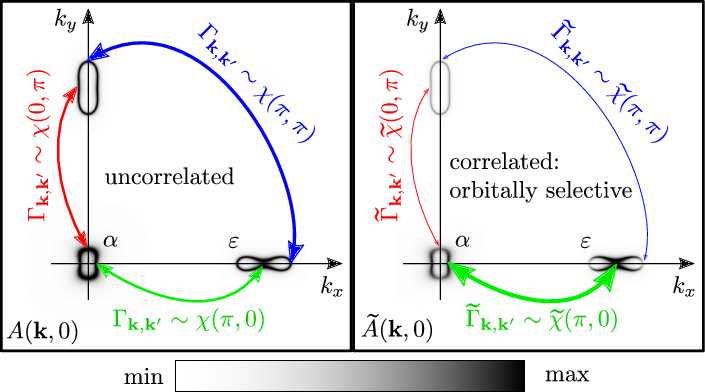
Modification of the pairing interactions (colored arrows) within the orbital selective pairing.
(Kreisel, et al., Phys. Rev. B 95, 174504 (2017))
Proposals for the pairing mechanism that leads to superconductivity, i.e. the glue that binds together electrons to form the Cooper pairs, need to be tested towards expected structures of the order parameter. Theoretically, one starts from a microscopic model for the pairing interaction and calculates for example the excitation gap in the superconducting state. This can be measured directly with spectroscopic probes, or has imprints on thermodynamic quantities as for example specific heat. Comparison to experimental results finally can decide whether the theoretical proposal is compatible with the observations or has to be rejected.
Theory for STM

Theoretically expected tunneling conductance close to a strong impurity in Cuprates within different approximations compared to experimental observations
(Kreisel, et al., Phys. Rev. Lett. 114, 217002 (2015))
The experimental tool of scanning tunneling microscopy delivers spectacular images of conducting surfaces on the atomic scale. It has been used to examine the normal state and the superconducting state of high-Tc materials. However, these materials are layered such that the tunneling out of the surface needs to take into account the wave function of the electronic state when calculating tunneling with sub-atomic resolution.
|