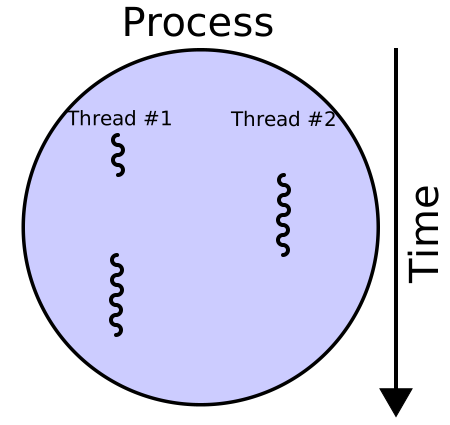
findall() | returning list with all matches |
search() | returns matching object, if existing |
split() | returns list of fragments |
replace() | replacing one or many matches |
| [ ] | set of characters |
| \ | special sequence (escape character) |
| . | as single character (except newline) |
| ^ | starts with |
| $ | ends with |
| * | zero or more occurrences |
| + | one or more occurrences |
| ? | zero or one occurrences |
| { } | exactly the specified number of occurrences |
| | | either or |
| ( ) | capture and grouping |
#!/usr/bin/env python3
import re # regular expressions
txt = "The rain in Spain falls mostly in ..."
# ... the plain.
xFind = re.findall("in", txt)
print("xFind : ", xFind)
xSplit = re.split(" ", txt)
print("xSplit : ", xSplit)
# splitting at first position
xSplit_1 = re.split(" ", txt, 1)
print("xSplit_1: ", xSplit_1)
# replace 3 times
xSub = re.sub(" ", "_", txt, 3)
print("xSub : ", xSub)
# search for an upper case "S" character
# in the beginning of a word
xSpan = re.search(r"\bS\w+", txt)
if xSpan:
print("match object :", xSpan)
print("matched text :", xSpan.group())
print("start index :", xSpan.start())
print("end index :", xSpan.end())
print("span :", xSpan.span())
lambda expressions are inline functions() at the end for immediate call
\
x%2 and 'odd' or 'even'
'odd' if x%2 else 'even'
sorted(): for any iterable (values only) list.sort(): idem for lists (in place)
enumerate(): : returns iterator over (key,value) tuples
#!/usr/bin/env python3
print("# *************************")
print("# simple lambda expressions")
print("# *************************")
x = lambda a : a + 10
print("lambda a : a + 10 :",x(5))
y = lambda a, b : a * b
print("lambda a, b : a * b :",y(5, 6))
# line continuation
# no empty space after '\'
z = lambda x: \
'odd' if x%2 else 'even' # inline 'if then else"
# x % 2 and 'odd' or 'even' # identical
print("\'odd\' if x%2 else \'even\' :",z(5))
print()
print("# **************************************")
print("# function returning a lambda expression")
print("# **************************************")
def myfunc(n):
return lambda a : a * n
mytripler = myfunc(3)
# equivalent to
# mytripler = lambda a : a*3
print("return lambda a : a * n :",mytripler(11))
print()
print("# ***********************")
print("# top-k (indices, values)")
print("# ***********************")
lst = [10, 3, 45, 6, 23, 89, 5]
print(" lst ", lst)
print("enumerate(lst) ", enumerate(lst))
print("list(enum(lst)) ", list(enumerate(lst))[:4])
print()
k = 3
sortedPairs = sorted(enumerate(lst), # tuples (index,value)
key=lambda x: x[1], # sort by values
reverse=True)
print("top-k entries ", sortedPairs[:k]) # slicing
print()
print("# **************")
print("# direct calling")
print("# **************")
print("(lambda x: x + 1)(2) :",(lambda x: x + 1)(2))
var.__add__(5) var+5
dir(int): directory listing of
magic methods (for int class) int.__dir__
#!/usr/bin/env python3
# as simple function
def myFunction(a):
return a**2
# intVar+5 is just a short for
# intVar.__add__(5)
intVar = 10
print()
print("using __add__() : ", intVar+5, intVar.__add__(5))
print()
print("*******************")
print("content of dir(int)")
print("*******************")
print()
#for mF in int.__dir__: # idem
for mF in dir(int): # dir: directory of magic methods
print(mF)
print()
print("**************************")
print("content of dir(myFunction)")
print("**************************")
print()
for mF in dir(myFunction):
print(mF)
threading.Thread() threading.Timer() if __name__ == "__main__":
#!/usr/bin/env python3
import threading, time, math
def fetch_data(source_id):
"""e.g., reading from file, doing math"""
print(f"starting fetch_data({source_id})")
#
if (1==2):
time.sleep(1)
else:
for _ in range(int(0.5e8)):
math.sqrt(3.3 * 3.3)
#
print(f"finishing fetch_data({source_id})\n")
return
# ***
# *** main start
# ***
start_time = time.time()
nJobs = 3
print("# --- ------------------ ---")
print("# --- sequential reading ---")
print("# --- ------------------ ---")
for i in range(nJobs):
fetch_data(i)
print(f"total time: {time.time() - start_time:.2f} seconds")
print()
print("# --- ------------------ ---")
print("# --- threaded execution ---")
print("# --- ------------------ ---")
start_time = time.time()
threads = []
# creating, storing, and starting threads
for i in range(nJobs):
t = threading.Thread(target=fetch_data, args=(i,))
threads.append(t)
t.start()
# waiting for all threads to complete, before moving on
for t in threads:
t.join()
print(f"total time: {time.time() - start_time:.2f} seconds")
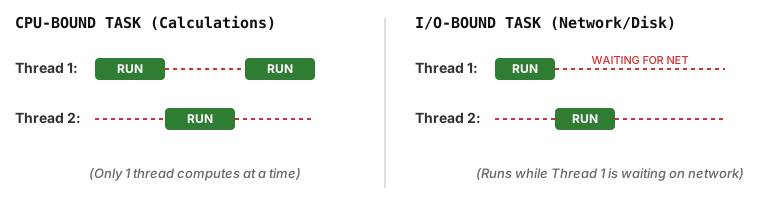
concurrent.futuresThreadPoolExecutor(max_workers=5)ProcessPoolExecutor(max_workers=5)executor.map()
#!/usr/bin/env python3
import threading, time
from concurrent.futures import ThreadPoolExecutor
def fetch_data(source_id):
"""e.g., reading from file"""
print(f"starting fetch_data({source_id})")
time.sleep(2) # simulated working time
print(f"finishing fetch_data({source_id})\n")
return "result " + str(source_id)
start_time = time.time()
print("# --- ------------------ ---")
print("# --- sequential reading ---")
print("# --- ------------------ ---")
sources = [1, 2, 3]
# ThreadPoolExecutor handles starting and joining threads automatically
with ThreadPoolExecutor(max_workers=3) as executor:
results = executor.map(fetch_data, sources)
for result in results:
print(result)
start(), join(), ...
#!/usr/bin/env python3
import threading, time, math, multiprocessing
def fetch_data(source_id):
"""e.g., reading from file, doing math"""
print(f"starting fetch_data({source_id})")
#
if (1==2):
time.sleep(1)
else:
for _ in range(int(0.5e8)):
math.sqrt(3.3 * 3.3)
#
print(f"finishing fetch_data({source_id})\n")
return
# ***
# *** main start
# ***
start_time = time.time()
nJobs = 3
print("# --- -------------------- ---")
print("# --- sequential execution ---")
print("# --- -------------------- ---")
for i in range(nJobs):
fetch_data(i)
print(f"total time: {time.time() - start_time:.2f} seconds")
print()
print("# --- ------------------ ---")
print("# --- threaded execution ---")
print("# --- ------------------ ---")
start_time = time.time()
threads = []
# creating, storing, and starting threads
for i in range(nJobs):
t = threading.Thread(target=fetch_data, args=(i,))
threads.append(t)
t.start()
# waiting for all threads to complete, before moving on
for t in threads:
t.join()
print(f"total time: {time.time() - start_time:.2f} seconds")
print()
print("# --- ---------------- ---")
print("# --- multi-processing ---")
print("# --- ---------------- ---")
start_time = time.time()
processes = []
# create separate OS processes (bypassing the GIL)
for i in range(nJobs):
p = multiprocessing.Process(target=fetch_data, args=(i,))
processes.append(p)
p.start()
# waiting for termination
for p in processes:
p.join()
print(f"total time: {time.time() - start_time:.2f} seconds")