Machine Learning Primer -- Python Tutorial


Claudius Gros, WS 2025/26

Institut für theoretische Physik
Goethe-University Frankfurt a.M.

Generative Architectures

natural language processing (NLP)


[Smerity]

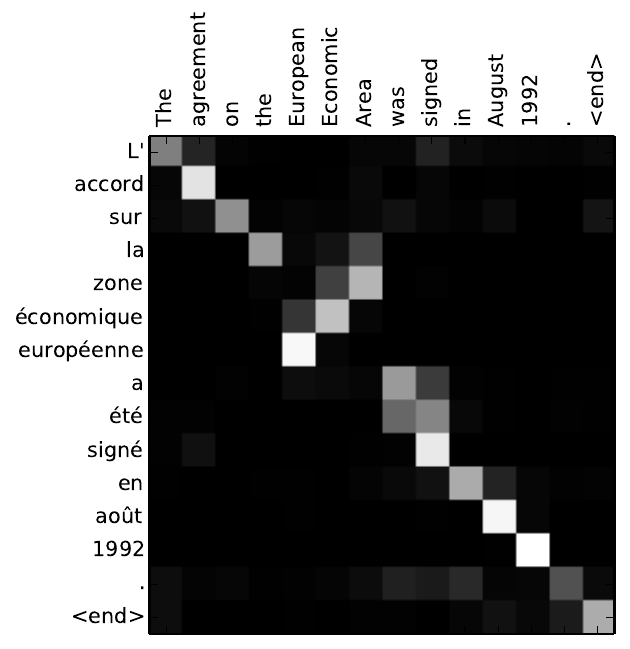
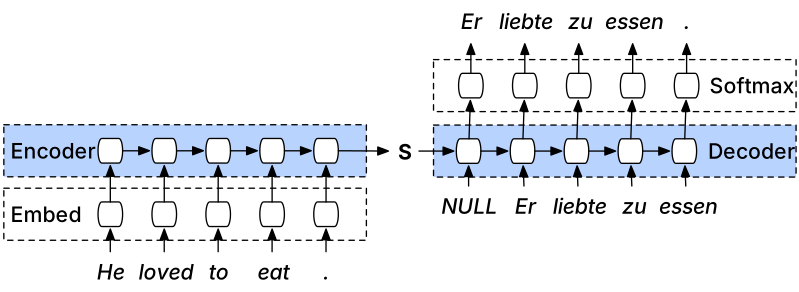
encoder-decoder architectures for NLP

word embedding

variants

semantic correlations

If the universe has an explanation of its existence,
that explanation is God.
[Mohebbi et al 2022]


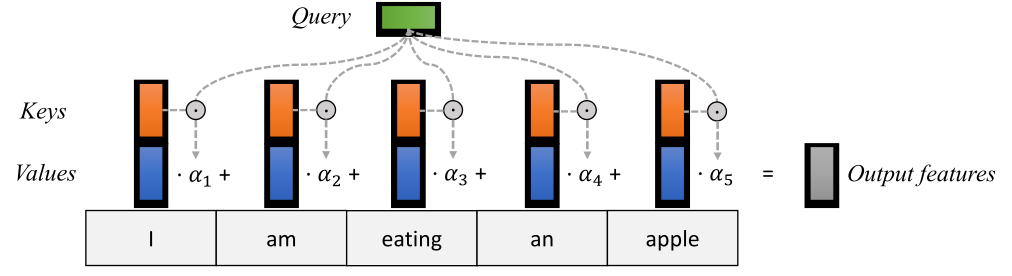
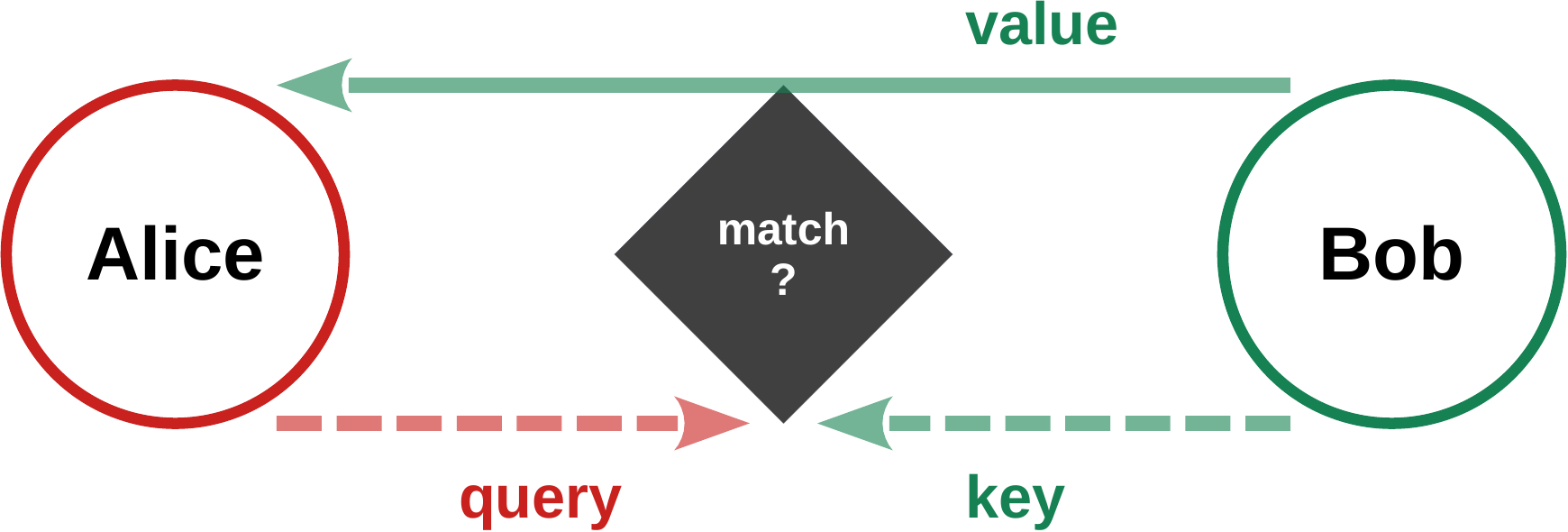
query, key & value

[Bahdanau, Cho, Bengio 2014]

attention: token-based information routing

$$ \mathbf{Q}_i = \hat{Q}\cdot\mathbf{x}_i,\qquad \mathbf{K}_i = \hat{K}\cdot\mathbf{x}_i,\qquad \mathbf{V}_i = \hat{V}\cdot\mathbf{x}_i,\qquad $$

Alice: should I pay attention to Bob?

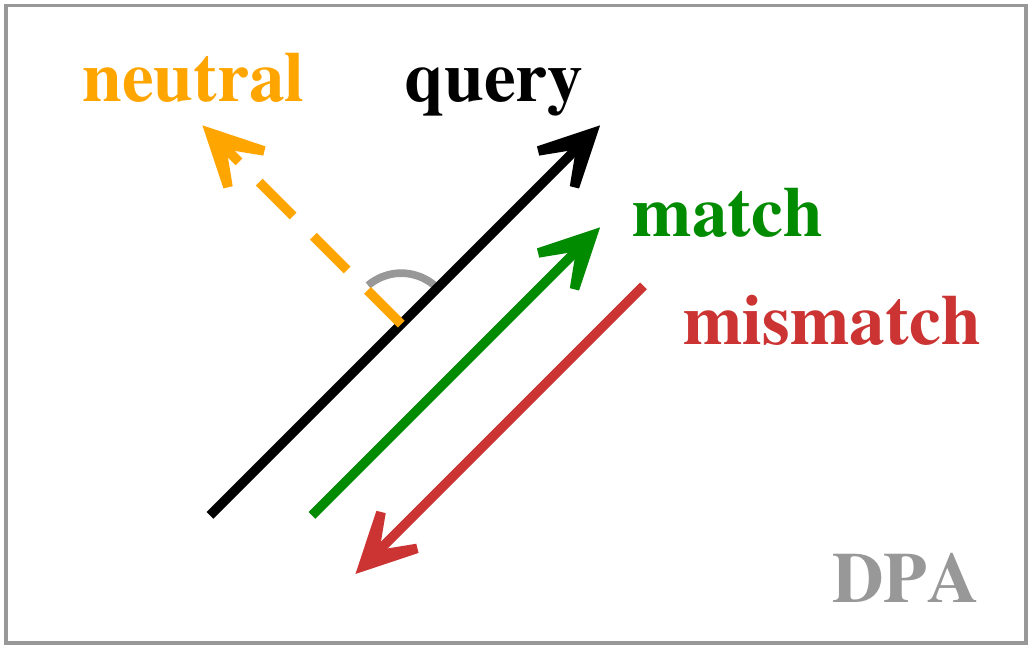
dot-product attention

[Attention Is All You Need (2017)]
[uvadlc-notebooks]
$$ \mathbf{a} = \sum_j \alpha_j\mathbf{V}_j, \quad\qquad \alpha_{j} = \frac{\mathrm{e}^{e_{j}}}{\sum_i\mathrm{e}^{e_{i}}} \quad\qquad e_{j} = \mathbf{Q}\cdot\mathbf{K}_{j} $$ [Bahdanau, Cho, Bengio 2014]

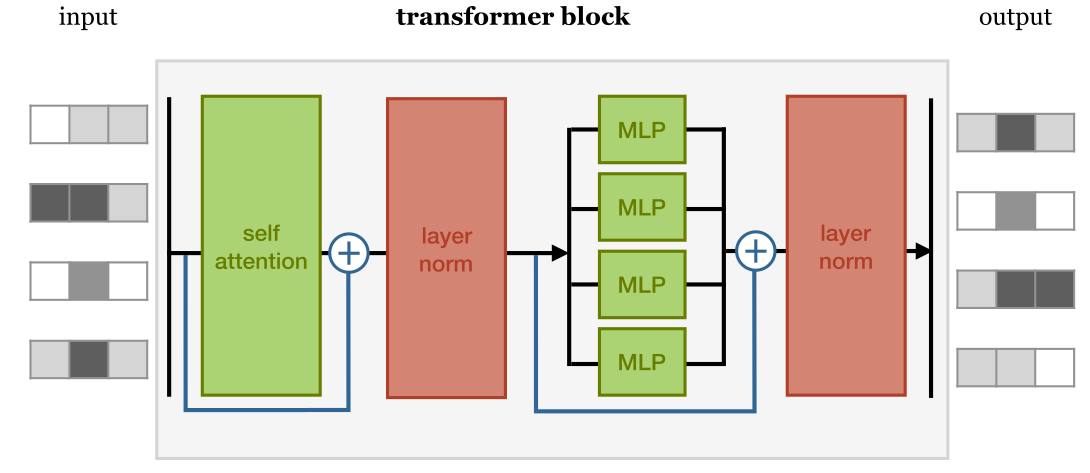
transformer block

[Attention Is All You Need (2017)]
[Peter Bloem]
$$ \begin{array}{ccccccc} \fbox{$\phantom{\big|}\mathrm{input}\phantom{\big|}$} &\to& \fbox{$\phantom{\big|}\mathrm{attention}\phantom{\big|}$} &\to& \fbox{$\phantom{\big|}\mathrm{normalization}\phantom{\big|}$} & & \\[0.5ex] &\to& \fbox{$\phantom{\big|}\mathrm{feed forward}\phantom{\big|}$} &\to& \fbox{$\phantom{\big|}\mathrm{normalization}\phantom{\big|}$} &\to& \fbox{$\phantom{\big|}\mathrm{output}\phantom{\big|}$} \end{array} $$

multi-headed attention

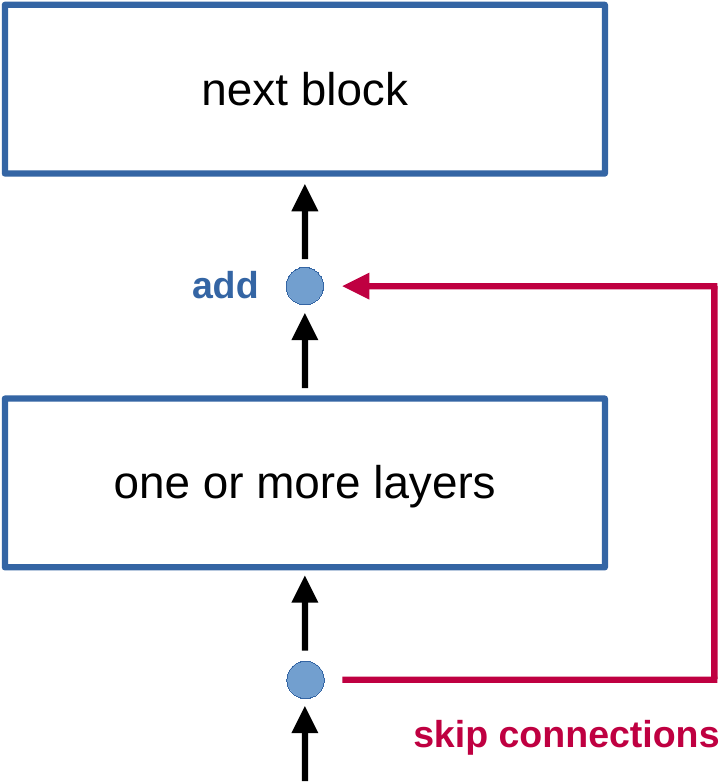
skip connections


skip/residual connections

advantages

transformer layer norm

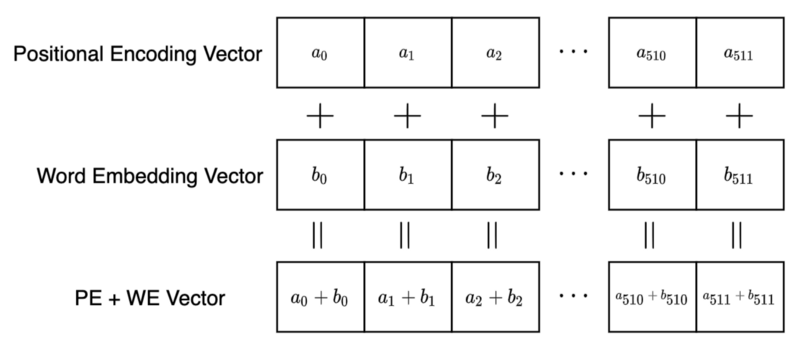
positional encoding

[Attention Is All You Need (2017)]

position of words

rotary positional encoding (RoPE)

[Su et al (2021/24)]
$$ \mathbf{x} = \big(x_1, x_2, \dots\big) \quad\to\quad \big(\vec{x}_1, \vec{x}_2,\dots\big), \quad\qquad \vec{x}_i = {x_i\choose y_i} $$ $$ \mathbf{Q}\quad \to\quad \big( \vec{Q}_1, \vec{Q}_2, \dots \big), \quad\qquad \vec{Q}_i = {Q_i^{(x)}\choose Q_i^{(y)}} $$ $$ \mathbf{Q}(l)\cdot \mathbf{K}(m) \ =\ \sum_i Q_i(l) K_i(m) \quad \to\quad \sum_i \vec{Q}_i(l)\cdot\vec{K}_i(m) $$

rotations in two dimensions

$$ \vec{K}_i(m) \quad\to\quad \left(\begin{array}{cc} \cos(m\theta_i) & -\sin(m\theta_i) \\ \sin(m\theta_i) & \cos(m\theta_i) \end{array}\right) \vec{K}_i(m) $$ $$ \vec{Q}_i(l) \cdot \vec{K}_i(m) \quad\to\quad \vec{Q}_i(l) \left(\begin{array}{cc} \cos((m-l)\theta_i) & -\sin((m-l)\theta_i) \\ \sin((m-l)\theta_i) & \cos((m-l)\theta_i) \end{array}\right) \vec{K}_i(m) $$
"attention (dot-product) knows about distances between words"

ALiBi positional encoding

$$ \mathbf{Q}_j\cdot \mathbf{K}_i \ \to\ \mathbf{Q}_j\cdot \mathbf{K}_i + m(i-j) \quad\qquad j\ge i \ \ \mathrm{(causal)} $$ $$ \mathrm{e}^{\mathbf{Q}_j\cdot \mathbf{K}_i} \ \to\ P(i-j) \mathrm{e}^{\mathbf{Q}_j\cdot \mathbf{K}_i} \quad\qquad P(i-j) = \mathrm{e}^{-m|i-j|} $$ $$ \fbox{$\phantom{\big|}\displaystyle m = \frac{1}{A^{h/N_{\rm head}}} \phantom{\big|}$} \quad\qquad h=1,\cdots,N_{\rm head} \quad\qquad A=2^8 $$
Copy Copy to clipboad
Downlaod Download
#!/usr/bin/env python3

# ALiBi positional embedding via broadcasting

import torch
import math

nC = 6       # context length
nHead = 2    # number of attention heads

rel_dist = torch.arange(0, nC).view(1, 1, nC) -\
           torch.arange(0, nC).view(1, nC, 1)
slopes = torch.tensor([1.0/(2.0**(h*1.0/nHead)) for h in range(nHead)])
biases = -slopes.view(nHead, 1, 1) * rel_dist.abs() 
ALiBi_tensor = biases.exp()

print(rel_dist)
print(slopes)
print(biases)
print(ALiBi_tensor)
print()
print("# === testing ===")
print()
test = torch.ones(nHead,nC,nC)
print(test)
print(ALiBi_tensor*test)
print()

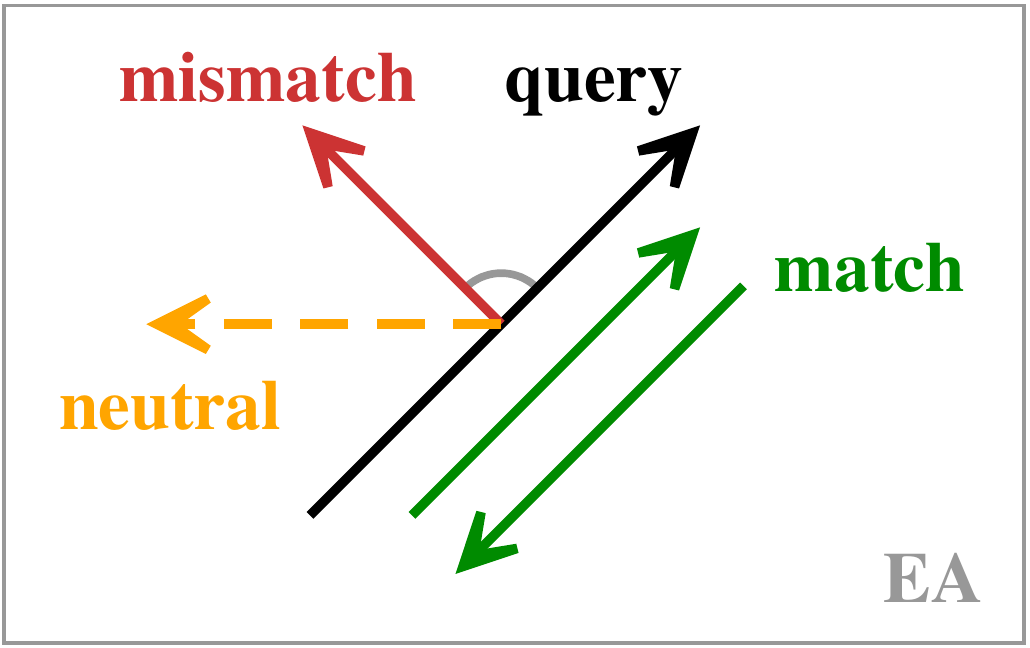
expressive attention


dot-product attention

expressive attention

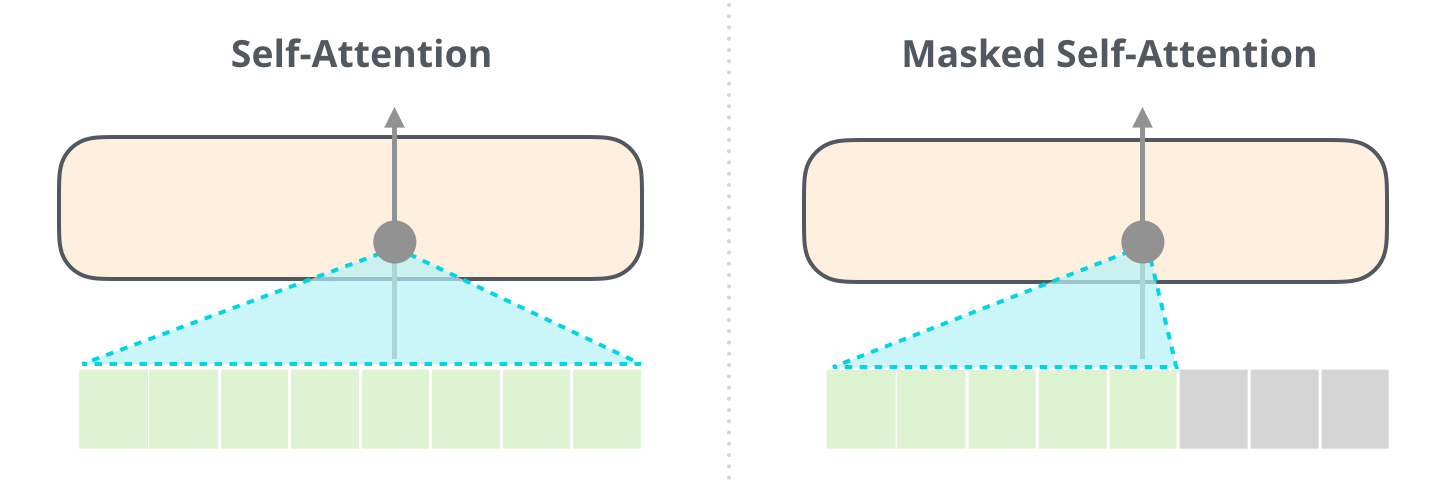
masked self attention


[Jay Alammar]

ordered input tokes

$$ \begin{array}{rcl} \mathbf{s}_q^{\mathrm{(head)}} &= & \sum_k \mathbf{V}_k\, \mathrm{softmax}\Big(F_a(\mathbf{K}_k,\mathbf{Q}_{q})\Big) \\[0.5ex] &\to& \frac{\sum_k\mathbf{V}_k \big(\mathbf{K}_k\,\cdot\,\mathbf{Q}_{q}\big)} {\sum_k \mathbf{K}_k\,\cdot\,\mathbf{Q}_{q}} = \frac{\big(\sum_k \mathbf{V}_k \otimes\mathbf{K}_k\big)\,\cdot\,\mathbf{Q}_{q}} {\big(\sum_k \mathbf{K}_k\big)\,\cdot\,\mathbf{Q}_{q}} \end{array} $$

associative soft weight computing

$$ W_m = W_{m-1} + \mathbf{V}_m \otimes\mathbf{K}_m $$ $$ \mathbf{V}_m \otimes\mathbf{K}_m = \mathbf{x}_m\,\cdot\,\big(\hat{V}_m \otimes\hat{K}_m \big)\,\cdot\,\mathbf{x_m} $$

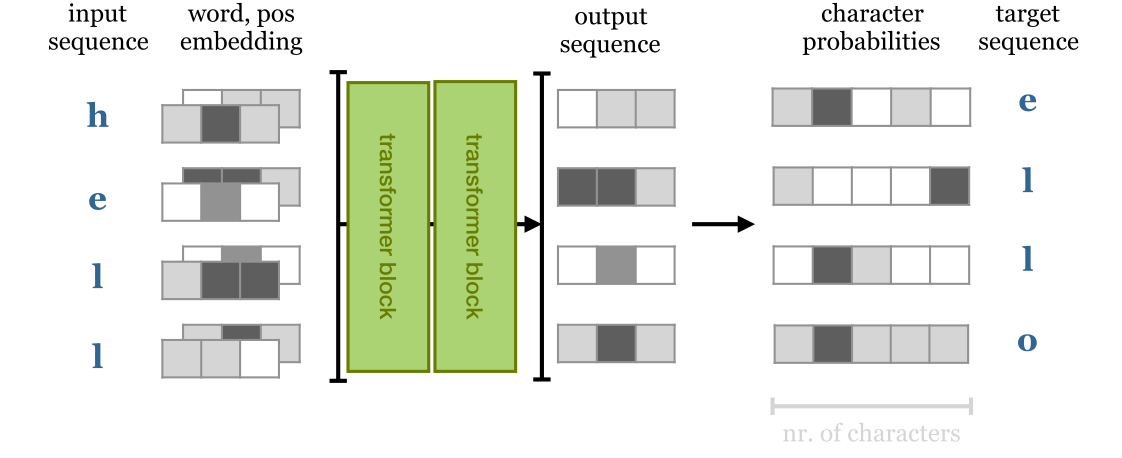
recursive prediction / character decoding

[Peter Bloem]

hello $\ \to\ $ hello

ouput  →  token probability

$$ p(T_j|\mathbf{y}) = \frac{1}{Z}\,\mathrm{e}^{\langle T_j|\mathbf{y}\rangle/T}, \quad\qquad Z = \sum_i \mathrm{e}^{\langle T_i|\mathbf{y}\rangle}, \quad\qquad \sum_j p(T_j|\mathbf{y}) = 1 $$

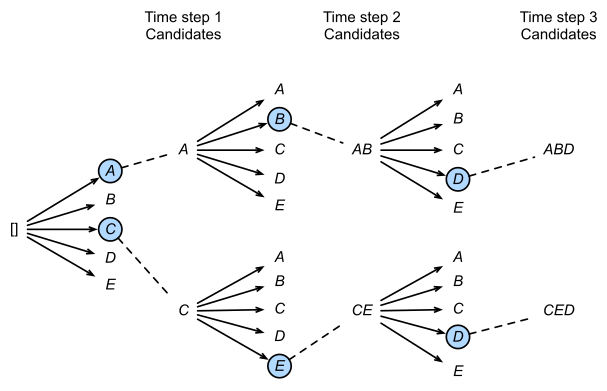
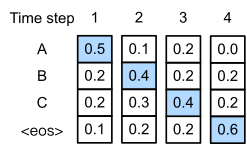
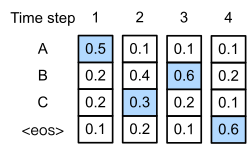
beam search / top-Z / top-p

text generation

not the most likely individual word/token,
but the most likely sentence


[Dive Into Deep Learning]

[How to generate text]

beam search variants

combined probabilities


why does it work?


attention in neuroscience / psychology


ML attention

active during training $\ \color{brown}\Rightarrow\ $ self-consitency loop


self-optimized information routing
solves the fitting / generalization dilemma

hands-on transformer bilayer code


Copy Copy to clipboad
Downlaod Download
#!/usr/bin/env python3

# basic attention layer
# no batch processing, no layer norm
import torch
import torch.nn.functional as F
import matplotlib.pyplot as plt

nLayer   = 24              # number of layers
nContext = 24              # context length
dim      =  2              # embedding dimension

nIter    = 4000            # training iterations
learning_rate = 1.0e-3

# ==========================
# transformer bilayer module
# attention plus FFN
# ==========================
class transformerBilayer(torch.nn.Module):
  def __init__(self, dim, nContext):
    """Q/K/V matrices will be broadcasted along the
       context dimension
    """
    super().__init__()
    self.alpha    = torch.zeros(nContext,nContext)
    self.nContext = nContext     # context length
    self.dim      = dim          # embedding dimension
    self.hidden   = 4            # hidden layer expanded size
#
# Q/K/V matrices: requires_grad after scaline
#
    mySigma = 0.1/(dim*dim)
    self.Q_mat = mySigma*torch.randn(1,dim,dim)
    self.K_mat = mySigma*torch.randn(1,dim,dim)
    self.V_mat = mySigma*torch.randn(1,dim,dim)
    self.Q_mat.requires_grad_(True)
    self.K_mat.requires_grad_(True)
    self.V_mat.requires_grad_(True)
#
# FFN: feed forward network  
#      FFN_1 --> hidden --> FFN_2
#
    self.FFN_1  = torch.randn(1,self.hidden*dim,dim)*mySigma
    self.FFN_2  = torch.randn(1,dim,self.hidden*dim)*mySigma
    self.FFN_b  = torch.randn(1,self.hidden*dim,requires_grad=True)
    self.FFN_1.requires_grad_(True)
    self.FFN_2.requires_grad_(True)
#
# padding mask for causal attention
#
    self.paddingMask = torch.zeros(nContext,nContext)   # for masking
    for ii in range(nContext):
      for jj in range(ii+1,nContext):
        self.paddingMask[ii][jj] = -1.0e9               # exp -> 0

  def FFN(self, x):
    """FFN sublayer
    """ 
# broadasting  (1,.. ,.. ) --> (context,.. ,.. )
    shape_1 = (self.nContext,self.hidden*self.dim,self.dim)
    shape_2 = (self.nContext,self.dim,self.hidden*self.dim)
    shape_b = (self.nContext,self.hidden*self.dim)
    FFN_1_all = self.FFN_1.expand(shape_1)
    FFN_2_all = self.FFN_2.expand(shape_2)
    FFN_b_all = self.FFN_b.expand(shape_b)
#
    xx = torch.einsum("chd,cd->ch",FFN_1_all,x)
    hh = torch.tanh(xx+FFN_b_all)
    yy = torch.einsum("cdh,ch->cd",FFN_2_all,hh)
    return yy + x


  def attention(self, x):
    """attention sublayer
    """ 
# broadasting  (1,dim,dim) --> (context,dim,dim)
    expanded_shape = (self.nContext,self.dim,self.dim)
    Q_all = self.Q_mat.expand(expanded_shape)
    K_all = self.K_mat.expand(expanded_shape)
    V_all = self.V_mat.expand(expanded_shape)
# c and C: context (input length)
# d and D: dim (enbedding dimension)
    QQ = torch.einsum("cdD,cD->cd",Q_all,x)
    KK = torch.einsum("cdD,cD->cd",K_all,x)
    VV = torch.einsum("cdD,cD->cd",V_all,x)
# normalized attention matrix
    logits  = torch.einsum("cd,Cd->cC",QQ,KK)
    alpha   = torch.exp(logits+self.paddingMask)
    row_sum = alpha.sum(dim=-1, keepdim=True) 
    alpha   = alpha / row_sum
#  store detached attention matrix
    self.alpha = alpha.detach()
# return with skip connections
    return torch.matmul(alpha,VV) + x   

  def forward(self, x):
    """indexing always from the back
    """ 
    x = self.attention(x)
    x = self.FFN(x)
    return x

  def update(self, eps):                # updating parameters
    with torch.no_grad():
      self.Q_mat -= eps*self.Q_mat.grad
      self.K_mat -= eps*self.K_mat.grad
      self.V_mat -= eps*self.V_mat.grad
      self.Q_mat.grad = None
      self.K_mat.grad = None
      self.V_mat.grad = None
      self.FFN_1 -= eps*self.FFN_1.grad
      self.FFN_2 -= eps*self.FFN_2.grad
      self.FFN_b -= eps*self.FFN_b.grad
      self.FFN_1.grad = None
      self.FFN_2.grad = None
      self.FFN_b.grad = None

# ======================
# n-idential layer model
# ======================
allLayers = [transformerBilayer(dim,nContext) for iL in range(nLayer)]
def model(x):
  for iLayer in range(nLayer):
    x = allLayers[iLayer](x)
  return x

# ====================================
# console printing of attention matrix
# ====================================
def printAttenionMatrix():
  for iLayer in range(nLayer):
    print()
    print("# attention matrix for layer ", iLayer)
    for ss in range(nContext):
      for tt in range(nContext):
         alpha = allLayers[iLayer].alpha[ss][tt]
         print(f'{alpha:9.4f}', end="")
      print()

# ======================
# standard loss function
# ======================
def lossFunction(outputActivity, targetActivity):
  return torch.square(outputActivity - targetActivity).sum()

# ================================================
# training data, token at position i: x[i]
# x[i+1] = x[i] - x[i-1]  (modulo normalization)
# settles into a limit cycle of period six 
# initial warm-up is discarded
# ================================================
def trainingSequence(seqLength, myDim):
  """generates a random vector difference sequence"""
  data    = torch.zeros(2*seqLength,myDim)
  data[0] = F.normalize(torch.randn(myDim), p=2, dim=0)
  data[1] = F.normalize(torch.randn(myDim), p=2, dim=0)
  for ss in range(2,2*seqLength):
    vector_sum = data[ss-1]-data[ss-2]
    data[ss] = F.normalize(vector_sum, p=2, dim=0)
  return data[seqLength:]        # discard warm-up phase

if (1==2):
  testLength = 20
  training_data = trainingSequence(testLength,dim)
  print("# --- training_data ---")
  for ll in range(testLength):
    for dd in range(dim): 
      print(f'{training_data[ll][dd]:8.3f}',end="")
    print()

# ===========================================
# training with random sequences
# token prediction == shifting prompt by (-1)
# ===========================================
print("# --- training ---")
for iIter in range(nIter):
  training_all   = trainingSequence(nContext+1,dim)
  training_data  = training_all[:-1]
  training_value = training_all[1:]
  loss = lossFunction(model(training_data),training_value)
  if (loss<0.001):
    break
  loss.backward()
#
  for iLayer in range(nLayer):
    allLayers[iLayer].update(learning_rate)
  if (iIter%200==0):                # print progress
    print(f'{iIter:4d} {loss.item():9.4f}')
#
# visual testing
#
test_all   = trainingSequence(nContext+1,dim)
test_data  = test_all[:-1]
test_value = test_all[1:]
yy = model(test_data)
print("# --- value vs. output ---")
for ll in range(nContext):
  for dd in range(dim): 
    print(f'{test_value[ll][dd]:8.3f}',end="")
  print(" |",end="")
  for dd in range(dim): 
    print(f'{        yy[ll][dd]:8.3f}',end="")
  print()
#
# print attention matrix
#
if (1==2):
  print()
  printAttenionMatrix()
functional transformer block

Copy Copy to clipboad
Downlaod Download
#!/usr/bin/env python3

# basic attention layer
# no batch processing, no layer norm
import torch
import torch.nn as nn
import torch.nn.functional as F
import matplotlib.pyplot as plt

nLayer   = 24              # number of layers
nContext = 24              # context length
dim      =  2              # embedding dimension

nIter    = 4000            # training iterations
learning_rate = 1.0e-3

# ==========================
# transformer bilayer module
# using torch.nn modules
# ==========================
class transformerBlock(nn.Module):
    def __init__(self, dim, nContext, hidden_mult=4):
        super().__init__()
        self.nContext = nContext

# LayerNorms for stability
        self.norm1 = nn.LayerNorm(dim)
        self.norm2 = nn.LayerNorm(dim)

# single-head attention
        self.attn = nn.MultiheadAttention(embed_dim=dim, 
                    num_heads=1, batch_first=True)

# feed-forward network
        self.ffn = nn.Sequential(
            nn.Linear(dim, hidden_mult * dim),
            nn.Tanh(),
            nn.Linear(hidden_mult * dim, dim)
        )

# causal mask
        mask = torch.triu(torch.ones(nContext, nContext)\
             * float('-inf'), diagonal=1)
        self.register_buffer("causal_mask", mask)

# store last attention weights for inspection
        self.alpha = torch.zeros(nContext, nContext)

    def forward(self, x):
        # (nContext, dim) → (1, nContext, dim)
        x = x.unsqueeze(0)

# attention with layer norm and skip connections
        x_norm = self.norm1(x)
        attn_out, attn_weights = self.attn(
            x_norm, x_norm, x_norm,
            attn_mask=self.causal_mask
        )
        self.alpha = attn_weights[0].detach()
        x = x + attn_out     

# feed-forward with layer normalization
        ff_out = self.ffn(self.norm2(x))
        x = x + ff_out 

        return x.squeeze(0)  # (nContext, dim)

    def update(self, eps):
        """manual SGD update with gradient clipping."""
        with torch.no_grad():
            torch.nn.utils.clip_grad_norm_(self.parameters(),
                                           max_norm=1.0)
            for p in self.parameters():
                if p.grad is not None:
                    p -= eps * p.grad
                    p.grad = None

# ======================
# n-idential layer model
# ======================
allLayers = [transformerBlock(dim,nContext) for iL in range(nLayer)]
def model(x):
  for iLayer in range(nLayer):
    x = allLayers[iLayer](x)
  return x

# ====================================
# console printing of attention matrix
# ====================================
def printAttenionMatrix():
  for iLayer in range(nLayer):
    print()
    print("# attention matrix for layer ", iLayer)
    for ss in range(nContext):
      for tt in range(nContext):
         alpha = allLayers[iLayer].alpha[ss][tt]
         print(f'{alpha:9.4f}', end="")
      print()

# ======================
# standard loss function
# ======================
def lossFunction(outputActivity, targetActivity):
  return torch.square(outputActivity - targetActivity).sum()

# ================================================
# training data, token at position i: x[i]
# x[i+1] = x[i] - x[i-1]  (modulo normalization)
# settles into a limit cycle of period six 
# initial warm-up is discarded
# ================================================
def trainingSequence(seqLength, myDim):
  """generates a random vector difference sequence"""
  data    = torch.zeros(2*seqLength,myDim)
  data[0] = F.normalize(torch.randn(myDim), p=2, dim=0)
  data[1] = F.normalize(torch.randn(myDim), p=2, dim=0)
  for ss in range(2,2*seqLength):
    vector_sum = data[ss-1]-data[ss-2]
    data[ss] = F.normalize(vector_sum, p=2, dim=0)
  return data[seqLength:]        # discard warm-up phase

if (1==2):
  testLength = 20
  training_data = trainingSequence(testLength,dim)
  print("# --- training_data ---")
  for ll in range(testLength):
    for dd in range(dim): 
      print(f'{training_data[ll][dd]:8.3f}',end="")
    print()

# ===========================================
# training with random sequences
# token prediction == shifting prompt by (-1)
# ===========================================
print("# --- training ---")
for iIter in range(nIter):
  training_all   = trainingSequence(nContext+1,dim)
  training_data  = training_all[:-1]
  training_value = training_all[1:]
  loss = lossFunction(model(training_data),training_value)
  if (loss<0.001):
    break
  loss.backward()
#
  for iLayer in range(nLayer):
    allLayers[iLayer].update(learning_rate)
  if (iIter%200==0):                # print progress
    print(f'{iIter:4d} {loss.item():9.4f}')
#
# visual testing
#
test_all   = trainingSequence(nContext+1,dim)
test_data  = test_all[:-1]
test_value = test_all[1:]
yy = model(test_data)
print("# --- value vs. output ---")
for ll in range(nContext):
  for dd in range(dim): 
    print(f'{test_value[ll][dd]:8.3f}',end="")
  print(" |",end="")
  for dd in range(dim): 
    print(f'{        yy[ll][dd]:8.3f}',end="")
  print()
#
# print attention matrix
#
if (1==2):
  print()
  printAttenionMatrix()
full micro code

Copy Copy to clipboad
Downlaod Download
#!/usr/bin/env python3
# basic transformer with batch processing and PyTorch optimizer
import torch
import torch.nn as nn
import torch.nn.functional as F
import matplotlib.pyplot as plt

nLayer   = 24              # number of layers
nContext = 24              # context length
dim      = 2               # embedding dimension
batch_size = 32            # batch size for training

nIter    = 4000            # training iterations
learning_rate = 1.0e-3

# ==========================
# transformer block module
# enhanced for batch processing
# ==========================
class transformerBlock(nn.Module):
    def __init__(self, dim, nContext, hidden_mult=4):
        super().__init__()
        self.nContext = nContext

# layer norm
        self.norm1 = nn.LayerNorm(dim)
        self.norm2 = nn.LayerNorm(dim)

# attention with num_heads heads
        self.attn = nn.MultiheadAttention(embed_dim=dim, 
                    num_heads=1, batch_first=True)

# FFN
        self.ffn = nn.Sequential(
            nn.Linear(dim, hidden_mult * dim),
            nn.Tanh(),
            nn.Linear(hidden_mult * dim, dim)
        )

# causal mask 
        mask = torch.triu(torch.ones(nContext, nContext) * float('-inf'),
                                     diagonal=1)
        self.register_buffer("causal_mask", mask)

    def forward(self, x):
# x shape: (batch_size, nContext, dim)
#       batch_size = x.size(0)
        x_norm = self.norm1(x)
        attn_out, attn_weights = self.attn(
            x_norm, x_norm, x_norm,
            attn_mask=self.causal_mask
        )
        
        x = x + attn_out     
        ff_out = self.ffn(self.norm2(x))
        x = x + ff_out 

        return x 

# ======================
# complete model class
# ======================
class TransformerModel(nn.Module):
    def __init__(self, dim, nContext, nLayer):
        super().__init__()
        self.layers = nn.ModuleList([
            transformerBlock(dim, nContext) for _ in range(nLayer)
        ])
    
    def forward(self, x):
        for layer in self.layers:
            x = layer(x)
        return x

# initialize model
model = TransformerModel(dim, nContext, nLayer)

# initialize optimizer
optimizer = torch.optim.Adam(model.parameters(), lr=learning_rate)

# ======================
# loss function
# ======================
def lossFunction(outputActivity, targetActivity):
    return torch.square(outputActivity - targetActivity).sum()

# ================================================
# training data generation
# x[i+1] = x[i] - x[i-1]  (modulo normalization)
# settles into a limit cycle of period six 
# initial warm-up is discarded
# ================================================
def trainingSequence(seqLength, myDim):
    """generates a random vector difference sequence"""
    data = torch.zeros(2*seqLength, myDim)
    data[0] = F.normalize(torch.randn(myDim), p=2, dim=0)
    data[1] = F.normalize(torch.randn(myDim), p=2, dim=0)
    for ss in range(2, 2*seqLength):
        vector_sum = data[ss-1] - data[ss-2]
        data[ss] = F.normalize(vector_sum, p=2, dim=0)
    return data[seqLength:]        # discard warm-up phase

def generateBatch(batch_size, nContext, dim):
    """generate a batch of training sequences"""
    batch_data = torch.zeros(batch_size, nContext, dim)
    batch_targets = torch.zeros(batch_size, nContext, dim)
    
    for b in range(batch_size):
        training_all = trainingSequence(nContext + 1, dim)
        batch_data[b] = training_all[:-1]
        batch_targets[b] = training_all[1:]
    
    return batch_data, batch_targets

# ===========================================
# training with batched random sequences
# ===========================================
print("# --- training with batches ---")
for iIter in range(nIter):

# generate batch / forward pass / loss
    training_data, training_targets = generateBatch(batch_size, nContext, dim)
    outputs = model(training_data)
    loss = lossFunction(outputs, training_targets) / batch_size
    if loss < 0.001:
        break
    
# backward pass, gradient clipping and udate
    optimizer.zero_grad()
    loss.backward()
    torch.nn.utils.clip_grad_norm_(model.parameters(), max_norm=1.0)
    optimizer.step()
    
# progress printing
    if iIter % 200 == 0:      
        print(f'{iIter:4d} {loss.item():9.4f}')

# ===========================================
# visual testing with single sequence
# ===========================================
print("# --- testing ---")
test_all = trainingSequence(nContext + 1, dim)
test_data = test_all[:-1].unsqueeze(0)  # Add batch dimension
test_value = test_all[1:]

with torch.no_grad():
    yy = model(test_data).squeeze(0)  # Remove batch dimension

print("# --- value vs. output ---")
for ll in range(nContext):
    for dd in range(dim): 
        print(f'{test_value[ll][dd]:8.3f}', end="")
    print(" |", end="")
    for dd in range(dim): 
        print(f'{yy[ll][dd]:8.3f}', end="")
    print()